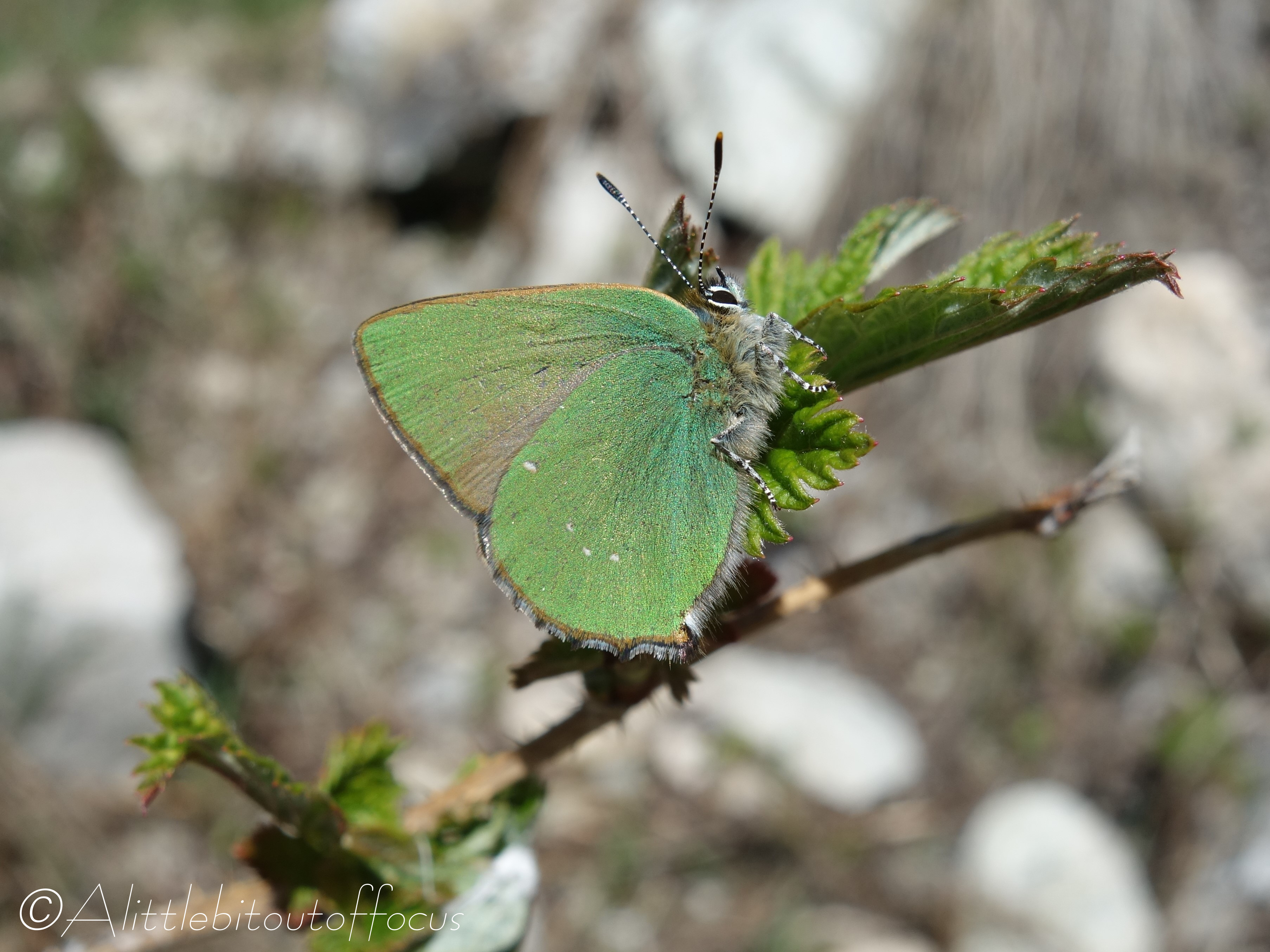
In what might become an occasional series, I’ve been encouraged by Brian at Butterflies to Dragsters to post some pictures of the various butterflies that I capture (outside of my walks) – starting with Green Hairstreaks that I photographed yesterday afternoon.
It was a warmish but breezy day, so I wasn’t too hopeful of seeing many on the wing but, hey, if you don’t go and look, you don’t find out… And often that leads to the best surprises.
I said to Jude that I’d only be about 20 to 30 minutes and I wandered up the small road which winds its way up to a dead end and the woods behind our group of chalets. Although there is nothing really to attract these wonderful little creatures, each of the 5 corners seems to be a magnet. And it was on the second corner that I took these photos – some on the way up and some on my return. Closer inspection reveals that they are all different (if we assume that the spots on opposite sides are equal).
As you may know, I like to educate as well as entertain, so…
Green hairstreaks or Callophrys rubi can be found all across Europe – even as far north as the Arctic and west to Siberia. So, I guess Switzerland is considered ‘warm’ by those standards! Though for some reason they are not present on the Outer Hebrides, the Orkneys or Shetlands, nor Crete for that matter. My book also says that they are one of the earlier species to take flight – that being between March and June. They are quite small, being only 15mm (0.6 inches) across, but they have adapted to quite a range of habitats, including scrubland and rocky places. That maybe explains why they are on the corner of our road, where a pile of (albeit rather nice) stones has been dumped by the local Commune workers. (I should have taken a picture – it’s delightful!)
I also got a little bit excited when I saw the line of white dots on the forewing of the 3rd photo – as there’s a variant called Chapman’s Green Hairstreak, which has that characteristic. However, it seems Chapman’s also have a rusty orange eye ring (not white), the inside of the antennae clubs is also rusty orange (not black), it has brown and white striped legs (not black and white) and the line of dots is generally further out than the hindwing. And, apart from all that, the nearest they ever get to here is the south of France. But a man can hope. 😊
Note that I normally shrink all my photos to around 250 to 300kb but these pictures have just been cropped and watermarked. Hopefully the extra quality shines through!?




 Alittlebitoutoffocus
Leave a reply to bayphotosbydonna Cancel reply